
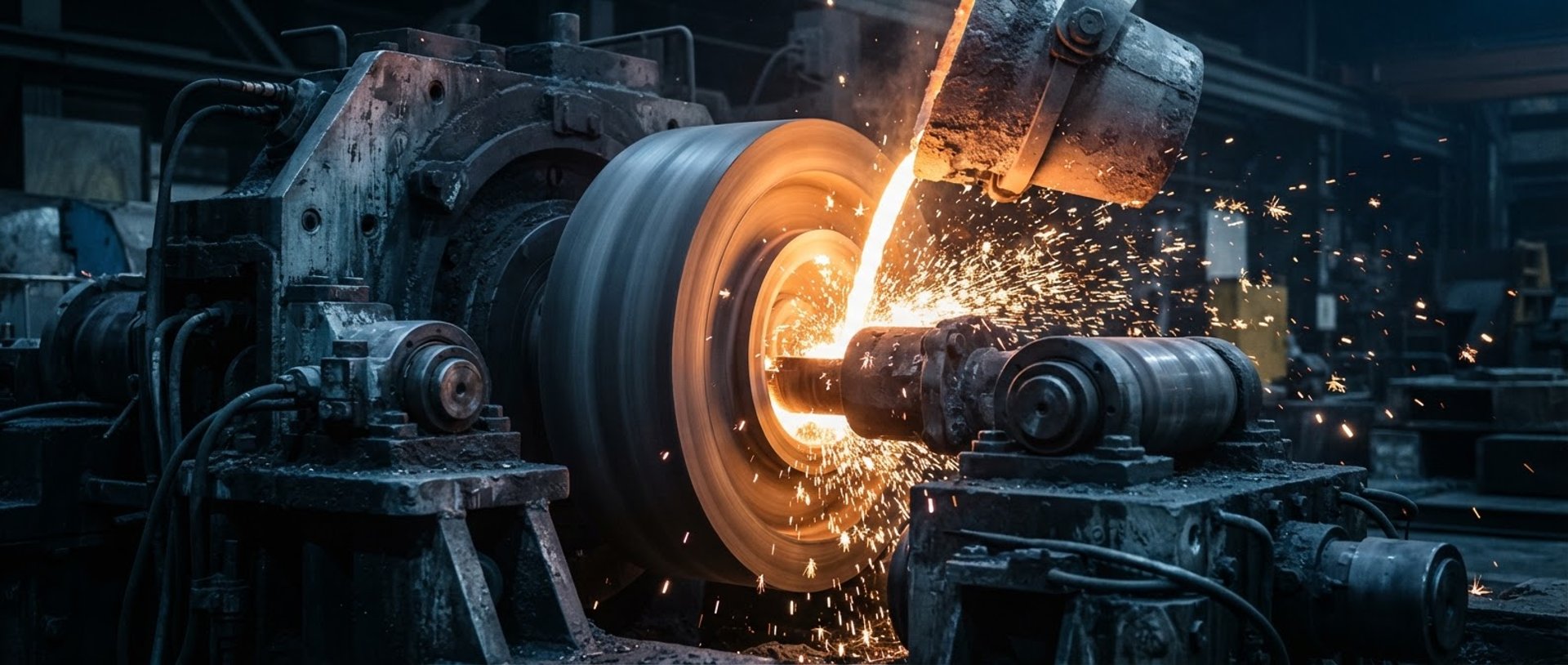
The Mechanics of Directional Solidification
By utilizing high centrifugal forces up to 100G, we eliminate gas porosity and force non-metallic impurities to the inner bore, delivering zero-defect components with refined grain structures.
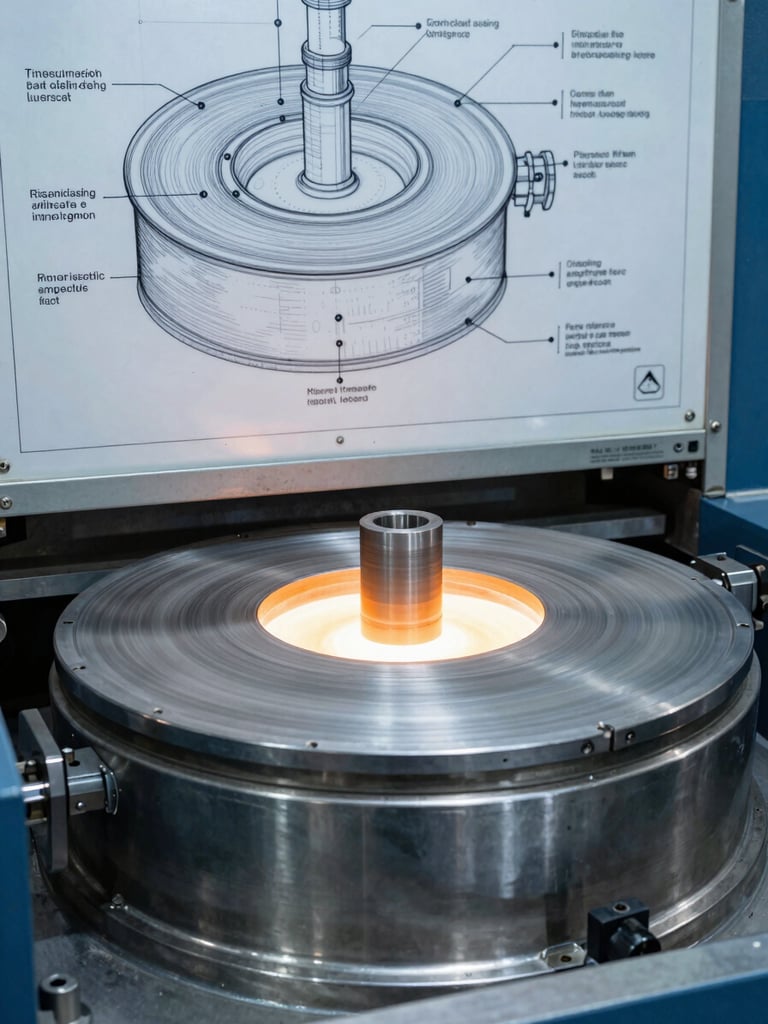
How Centrifugal Force Refines Metal
During rotation, centrifugal force exceeding 100 times gravity forces the heavier, dense molten alloy outward against the mold wall. This intense pressure forces lighter oxides, slag, and gas bubbles to migrate inward to the inner diameter bore.
As the component cools, our precise thermal management ensures directional solidification from the outside in. This progressive crystallization prevents shrinkage cavities, ensuring a completely solid, high-density grain structure ready for precision machining.
Engineered to Outperform Sand Castings
Centrifugal casting produces physical properties that match or exceed those of forged components, without the directional weaknesses of traditional sand molds.
Zero Gas Porosity
Refined Grain Structure
Machined Purity
High centrifugal force eliminates trapped air and gas pockets, producing a uniform, high-density alloy structure that resists high-pressure failures.
Rapid cooling against the metal mold induces directional solidification, creating a fine, equiaxed grain boundary with superior tensile strength.
Because lighter oxides float to the inner bore, we machine away the inner layer entirely, leaving a 100% pure, defect-free metal cylinder.
Four Stages of Metallurgical Integrity
Spectrometric Melt Preparation
High-Speed Die Rotation
Controlled Pour & Solidification
Bore Machining & Inspection
The mold is coated with a refractory wash and spun at calculated RPMs to generate the required centrifugal force for the specific alloy.
The inner bore containing the concentrated impurities is machined out on our CNC lathes, followed by rigorous NDT testing.
We formulate the alloy in our induction furnaces, verifying the exact elemental composition with our 8-channel spectrometer before pouring.
Molten metal is introduced into the spinning die, solidifying progressively from the outer diameter inward to prevent shrinkage cavities and micro-porosity.
Necleus Centricast Pvt. Ltd.
Precision Centrifugal Casting & Metallurgical Integrity
SITEMAP
Home
About
Process
Products
Facilities & Quality
Contact
ENGINEERING DESK
Nikunj: nikunj.necleus@gmail.com | +91 9825290035
Girish: girish.necleus@gmail.com | +91 9904502999
Plot No. 559/6, Patel Compound, Phase - 4, Vatva GIDC, Ahmedabad, Gujarat, India
© 2026 Necleus Centricast Pvt. Ltd.-Ready-to-install centrifugal casting solutions since inception.
METALLURGICAL INTEGRITY BY DESIGN